
· Matthias Berger
Basics of Animal Tracking Databases
“ChatGPT, Please create a Next Gen Animal Tracking Database for me…”
Designing a robust database for animal tracking can be challenging, but it doesn’t have to be complicated. Let’s break down the essentials in a simple and engaging way.
There are a lot of opinions on what the right technology might be for animal tracking databases. At the end of the day, we need something that works for the everyday user of animal tracking data. Let’s look at some facts.
For example, a preliminary analysis of publicly available Movebank studies reveals that the median study contains:
- 10 Tags
- 10,000 Locations
That’s perfectly fine for SQL. We can work with that.
Don’t get me wrong—there are amounts of data and especially “rates of data” in real-time monitoring tracking systems which are problematic for a pure SQL approach. But there are many more challenges than simply switching to something NoSQL-ish. Let’s keep that for the “Non-Basics of Animal Tracking Databases” article.
The Immense Advantages of SQL Databases
SQL databases shine in their ability to manage structured data efficiently. They offer powerful querying capabilities, robust transactional support, and strong data integrity through ACID compliance. With a mature ecosystem of tools and widespread adoption, SQL databases provide excellent scalability for moderate data sizes and are a trusted choice for applications requiring complex relationships, such as animal tracking systems. Their familiarity among developers also ensures faster development and maintenance cycles.
In the context of animal tracking, SQL databases excel in managing structured data like study metadata, tag information, and deployment details while ensuring integrity and consistency across related entities.
Core Entities in an Animal Tracking Database
Let’s have a look at the basic entities in an animal tracking database.
Take a look at this simple model of Movebank, available here: Movebank Data Model
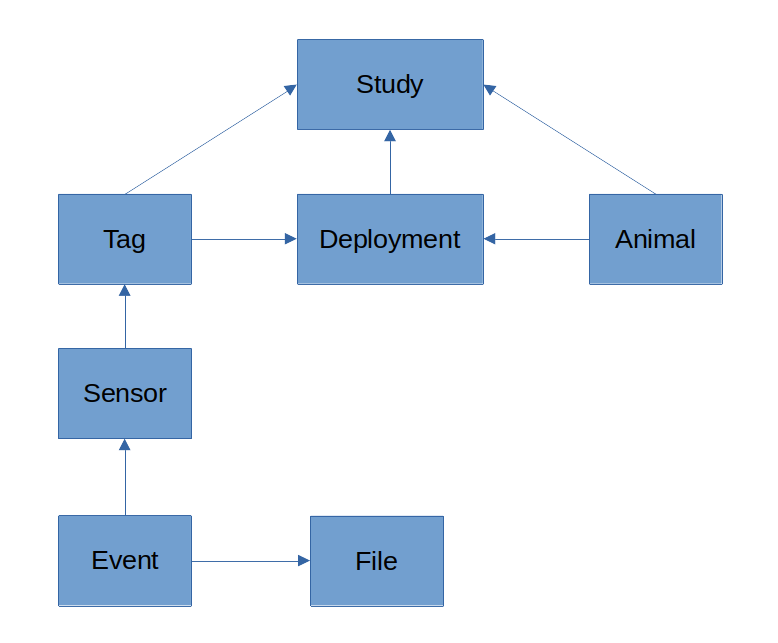
The basic entities are:
- Study
- Tag
- Deployment
- Animal
- Event (just location events in our case)
I will only focus on location data for the moment.
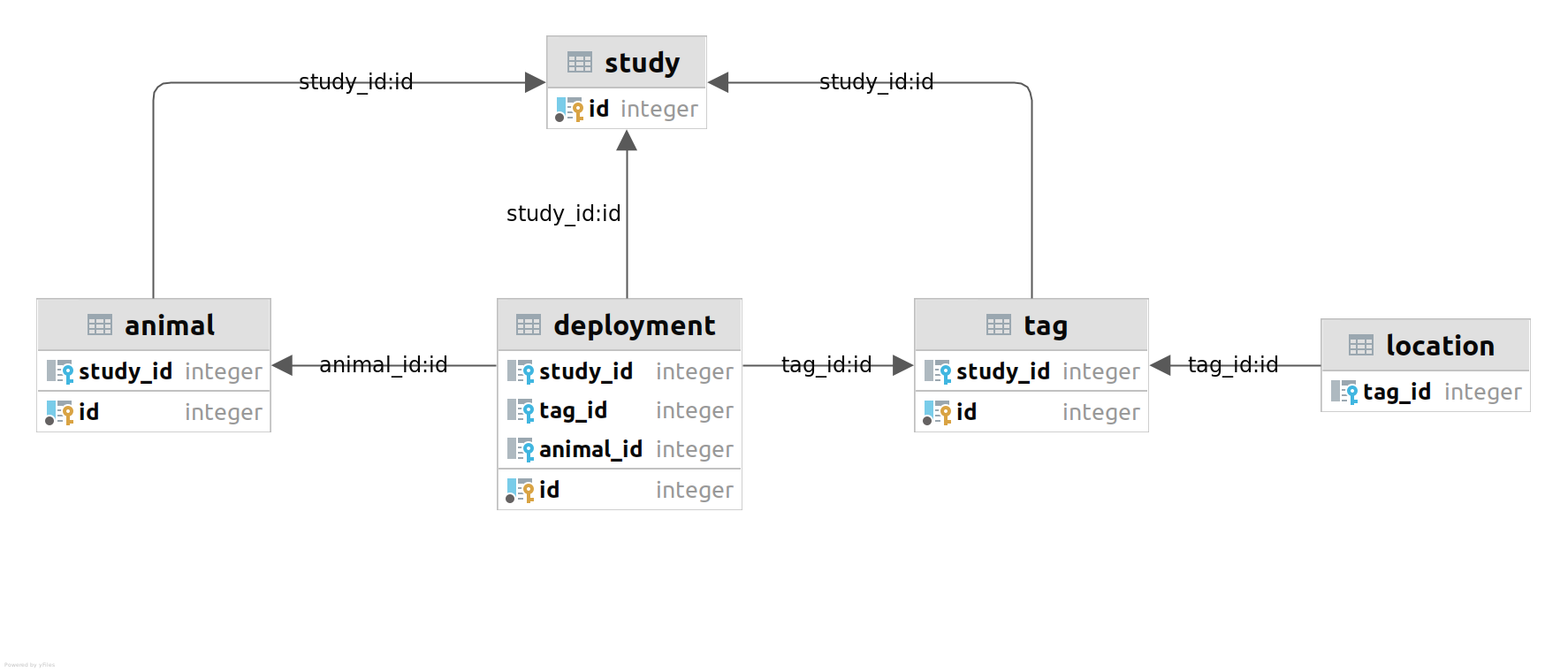
Refer to the simple Entity-Relationship diagram below for a visual representation.
What Do These Entities Mean?
Study:
The study is the enclosing entity. It holds Tags, Deployments, Animals, and the location data.
Tag:
The tag represents the physical tracking device which collects the location data. Therefore, the location data is associated with the Tag.
Location:
The location entity stores GPS coordinates and is linked to a specific tag.
Animal:
This represents the living animal whose location is collected by the tracking device.
Deployment:
The deployment describes the fact that the tracking device is mounted on an animal for a defined amount of time or time range.
The same tracking device can be used on different animals across different time ranges. However, under normal physical conditions, a tracking device could only be mounted to exactly one animal at a point in time.
What’s Missing?
Well, everything else. While these are the fundamental entities, there are plenty of other things to consider when building a fully-fledged tracking database, such as:
- Users
- Access Rights
- Data Imports
- Data Formats
- Sensor Types (for everything besides basic location data)
- Visualization
We might dive into these very interesting parts of an animal tracking database later.
Refined Data Model
For now, let’s refine the data model and introduce some fields and key data types to make everything more relatable.
Here are the key fields for the Study entity:
| Field | Type | Description |
|---|---|---|
study_id | ID | Unique identifier for the study. |
study_name | String | Name of the study. |
Tag
| Field | Type | Description |
|---|---|---|
tag_id | ID | Unique identifier for the tag. |
study_id | Foreign Key | Links the tag to its associated study. |
tag_manufacturer | String | Manufacturer of the tracking device. |
tag_model | String | Model of the tracking device. |
Location
| Field | Type | Description |
|---|---|---|
tag_id | Foreign Key | Links the location data to its associated tag. |
location_longitude | Number | Longitude coordinate of the location. |
location_latitude | Number | Latitude coordinate of the location. |
location_timestamp | Timestamp | Timestamp when the location was recorded. |
Animal
| Field | Type | Description |
|---|---|---|
animal_id | ID | Unique identifier for the animal. |
study_id | Foreign Key | Links the animal to its associated study. |
animal_name | String | Name of the animal. |
animal_sex | String | Sex of the animal. |
animal_species | String | Species of the animal. |
Deployment
| Field | Type | Description |
|---|---|---|
deployment_id | ID | Unique identifier for the deployment. |
study_id | Foreign Key | Links the deployment to its associated study. |
tag_id | Foreign Key | Links the deployment to its associated tag. |
animal_id | Foreign Key | Links the deployment to its associated animal. |
deployment_start_timestamp | Timestamp | Start time of the deployment. |
deployment_end_timestamp | Timestamp | End time of the deployment. |
How does the refined Entity-Relationship diagram look?
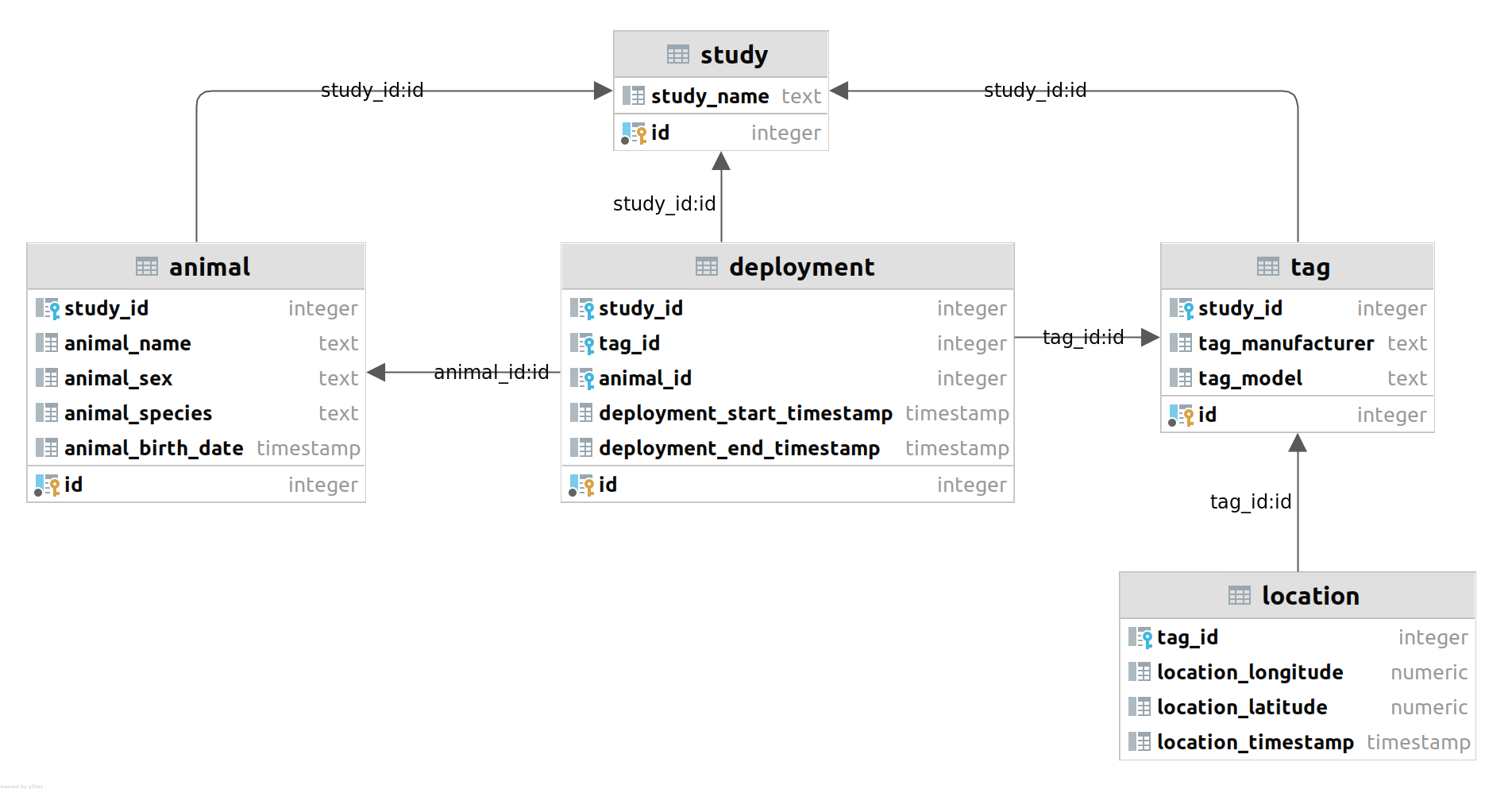
That’s looking good!
What’s Next?
In the next post, we’ll explore what this looks like in PostgreSQL, our database of choice for things like this.
If there are specific things you’re interested in, just ask!
About the Author
Matthias Berger has been a key member of the Movebank Development Team since its inception in 2008, contributing to the advancement of animal tracking databases and supporting researchers worldwide.